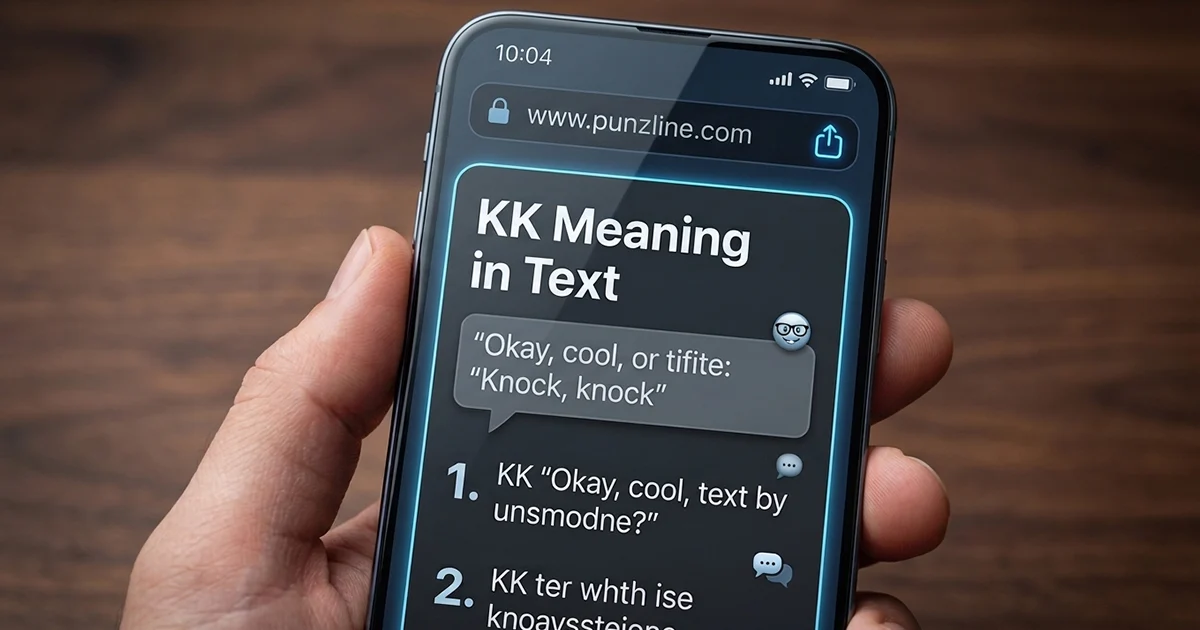
Ever received a simple “kk” in a text and wondered what the person really meant? The kk meaning in text is usually a quick way to say “okay” but the tone can vary depending on the situation.
If you’re searching what does kk mean in text kk meaning in texting or kk meaning in chat you’re likely trying to understand whether it shows agreement acknowledgment or something more dismissive. A kk reply meaning can also depend on the relationship and context which is why people often ask is kk rude in texting?
As a common kk slang meaning “kk” generally means “okay” rather than having a complicated hidden message. But what does kk stand for exactly and how should you respond when someone sends it? Let’s break it down.
Quick Answer
KK in text usually means “okay.” It is a short texting abbreviation people use to acknowledge a message, confirm something, or show that they understand. The kk meaning in text is generally simple and casual rather than having a hidden meaning.
For example, if someone texts “I’ll call you later” and you reply “kk”, you are essentially saying “okay” or “alright.” The meaning can shift slightly with context and punctuation. A friendly conversation may make “kk” feel relaxed while a very short “kk.” can sometimes sound cold or dismissive.
KK is common in texting, chat apps, social media and casual online conversations. Understanding the surrounding conversation is the best way to judge the intended tone.
What Does KK Mean in Text
The most common kk meaning in text is “okay.” It is an informal way to acknowledge what someone has said without typing the full word. In everyday messaging, people may use it to confirm information, accept a suggestion or simply let someone know they have seen the message.
For example:
- “Meet me at 7.”
“kk” - “Don’t forget your charger.”
“kk I won’t.” - “I sent you the details.”
“kk thanks.”
The abbreviation can also communicate slightly different shades of meaning. Depending on the conversation, kk may mean “I understand,” “sure,” “alright,” “got it” or “okay then.”
This is why what does kk mean in text does not always have one fixed emotional interpretation. The words around it, the relationship between the people and the usual texting style all matter.
Another important point is that kk is generally casual. You would normally see it in conversations with friends, classmates, family members or people you regularly message. In professional communication, writing “okay,” “sure,” or “understood” may be clearer and more appropriate.
Why People Use KK Instead of OK
People use kk instead of ok mainly because it is quick, familiar and easy to type. Texting culture has encouraged shorter responses for years and kk fits naturally into fast-paced conversations.
There is also a subtle difference in how people perceive the two forms. “OK” can look neutral while “kk” often feels more casual and conversational. Someone might type kk simply because it matches the relaxed tone of the chat.
Common reasons people use kk include:
- Quick acknowledgment: They want to show they read your message.
- Agreement: They accept what you suggested.
- Confirmation: They understand the information.
- Casual communication: They want to keep the conversation informal.
- Fast replies: Typing two letters is easier than writing a complete response.
For example, if a friend says “I’m leaving in five minutes”, replying “kk” usually means “okay, got it.” There is normally no deeper message behind it.
However, tone can depend heavily on context. If someone normally sends long and enthusiastic messages but suddenly responds with only “kk”, you might wonder whether something is wrong. That does not automatically mean they are upset. They could simply be busy, distracted or replying quickly.
How to Use KK in Text Conversations
KK works best when the conversation is already casual. It can be used as a short acknowledgment when you do not need to add much to the discussion.
For instance:
Friend: “I’ll pick you up after class.”
You: “kk”
Here kk naturally means “okay” or “sounds good.”
You can also combine it with other words when you want the message to feel warmer or more specific:
“kk thanks” — okay, thanks
“kk got it” — okay, I understand
“kk see you then” — okay, see you at that time
“kk sure” — okay, sure
“kk I’ll do it” — okay, I’ll take care of it
The main thing to remember is that kk is an acknowledgment rather than a detailed response. If someone has asked you a question that requires an explanation, simply replying kk may make it seem like you ignored the actual question.
It is also worth paying attention to punctuation. “kk” often feels casual and neutral. “kk!” can sound more upbeat while “kk.” may feel more final or serious depending on the person and the conversation.
Real Text Message Examples
Real conversations make the kk meaning in texting much easier to understand because the same abbreviation can work differently in different situations.
Example 1: Simple agreement
A: “Let’s meet at the coffee shop at 5.”
B: “kk”
Here kk means “okay” or “sounds good.”
Example 2: Confirming information
A: “Your appointment is tomorrow at 10 AM.”
B: “kk thanks”
In this situation, the reply confirms that the information was received and understood.
Example 3: Among friends
A: “Send me the pictures when you get home.”
B: “kk I will”
This sounds relaxed and friendly because the abbreviation is followed by a clear response.
Example 4: A very short reply
A: “Can you stop doing that?”
B: “kk”
Here the meaning is still basically “okay”, but the emotional tone is less certain. Depending on the previous messages, it could show genuine agreement, irritation or an attempt to end the discussion.
Example 5: Casual planning
A: “I’ll text you when I’m outside.”
B: “kk see you”
This is a natural use of kk because there is no need for a long response.
These examples show why the kk reply meaning should not be judged from the abbreviation alone. The surrounding words provide important clues.
Is KK Rude or Polite
KK is not automatically rude. In most casual texting situations, it is simply a short and informal way to say “okay.” Whether it feels polite, neutral or slightly cold depends on context and the people involved.
Among close friends, a reply such as “kk” is usually completely normal. If the conversation is more serious, however, a two-letter response may appear uninterested because it provides very little emotional information.
For example:
“Thanks for helping me today!”
“kk”
This could feel unusually dry because the sender may expect a warmer response such as “no problem” or “anytime.”
That is why people often ask “is kk rude in texting?” The answer is generally no, but it can sometimes be perceived as dismissive when the situation calls for more engagement.
If you want to sound warmer, you can add a few words:
- “kk sounds good”
- “kk no problem”
- “kk thank you”
- “kk I understand”
- “kk see you soon”
The relationship also matters. A close friend may interpret kk as completely normal while someone you barely know could read the same reply differently.
KK Meaning From a Girl vs Guy
The kk meaning from a girl vs guy is usually not fundamentally different. In both cases, kk most commonly means “okay,” “alright,” or “got it.” The person’s gender does not provide enough information to determine a special meaning.
What matters more is context, personality, relationship and texting habits. Someone who regularly uses short replies may send kk without intending anything negative. Another person who normally uses emojis and longer responses might use kk in a more restrained or serious way.
For example, if a girl texts:
“I’ll talk to you tomorrow.”
“kk”
That could simply mean “okay.”
Likewise, if a guy says:
“I’ll be there at 8.”
“kk”
The meaning is essentially the same.
People sometimes assume that kk from a girl means she is annoyed or that kk from a guy means he is uninterested. Those interpretations can happen in specific conversations, but they cannot be determined from kk alone.
Look for stronger context clues instead. Changes in response length, punctuation, emojis, previous messages and the overall flow of the conversation can provide much better clues about someone’s tone.
How to Respond When Someone Says KK
The best response to kk depends on whether the conversation is finished or whether you want to keep it going. Since kk usually means “okay,” you often do not need to respond at all if the conversation has naturally reached an ending.
If you want to continue chatting, respond according to the situation rather than focusing too much on the abbreviation.
For a simple acknowledgment:
Them: “I’ll see you at 6.”
You: “Sounds good!”
For a friendly conversation:
Them: “kk”
You: “Perfect 😊”
If you need confirmation:
Them: “kk”
You: “Cool, so we’re still meeting at 7?”
If you think their reply sounds unusually short, avoid immediately assuming they are angry. You can simply continue naturally or ask:
“Everything good?”
If the conversation is casual and there is nothing else to discuss, leaving kk without another response is also completely normal.
The key is to judge the whole conversation, not just two letters. A short reply can reflect agreement, busyness, distraction or a desire to end the conversation. Looking at the person’s usual communication style gives you a much more reliable idea of what their kk meaning in chat actually is.
KK Meaning in Text
KK Meaning in Different Contexts
The kk meaning in text is usually “okay” or “alright.” It is a short texting abbreviation used to acknowledge a message, confirm something, or show that the person understands. However, its exact tone depends heavily on the conversation and the relationship between the people texting.
In a friendly conversation, “kk” can sound relaxed and completely normal. For example:
Person 1: “I’ll call you after dinner.”
Person 2: “Kk.”
Here, the reply simply confirms that the message was understood. It does not necessarily carry any negative meaning.
The kk meaning in chat can change when the conversation is tense or emotional. A person who normally sends detailed replies may use “kk” suddenly to signal that they do not want to continue the conversation. In that situation, the surrounding messages matter more than the abbreviation itself.
“KK” can also appear in different forms such as kk, KK, or Kk. The capitalization usually does not create a completely different meaning. Context, punctuation, timing, and the sender’s usual texting style are more useful clues.
How to Respond to KK in a Text
How you should respond to kk depends on what the conversation requires. If the person is simply acknowledging information, you may not need to reply at all. Continuing the conversation with another relevant message is often more natural than sending another acknowledgment.
For example:
You: “The meeting starts at 7 tonight.”
Them: “Kk.”
You: “Great. See you there.”
If the conversation has already reached a natural stopping point, leaving the message without a response is perfectly reasonable.
When you want to keep talking, respond with something that adds value rather than repeating “okay.” You could ask a question or introduce the next part of the conversation.
Them: “Kk.”
You: “Are you still coming with us?”
If the short reply seems unusually cold, avoid immediately assuming that the person is angry. People often use brief responses when they are busy, distracted, tired, or simply texting quickly.
Is KK Flirty
KK is not inherently flirty. In most texting situations, it simply means “okay” or “alright.” Its basic meaning does not indicate romantic interest.
That said, context can influence how a message feels. If two people are already flirting, even a simple “kk” can become part of a playful conversation. The flirtatious meaning comes from the broader interaction rather than from the letters themselves.
For example:
Person 1: “You better save me a seat tomorrow 😉”
Person 2: “Kk 😏”
The emojis and surrounding conversation create the playful tone. Without that context, “kk” is normally just a casual acknowledgment.
If you are trying to determine whether someone likes you, do not rely on kk alone. Look at broader communication patterns such as whether they initiate conversations, ask questions, respond consistently, and show genuine interest.
KK vs K vs OK
Although K, KK, and OK can all communicate agreement, they may create different impressions in everyday texting.
| Text | Common meaning | Typical tone |
| K | Okay | Can feel very brief or cold |
| KK | Okay / Alright | Usually casual and relaxed |
| OK | Okay | Neutral and straightforward |
| Okay | Okay / I understand | Clearer and often warmer |
| Okk | Okay | Casual and sometimes playful |
The important difference is that K can sometimes sound more abrupt than KK. For example, replying “K” to a long or emotional message may make the other person feel dismissed.
“KK” often softens that short response because it feels more conversational. Still, this is not a universal rule. People have different texting habits, and someone who regularly writes “K” may not intend any negativity.
When the conversation is important or sensitive, writing the complete word “okay” can remove unnecessary ambiguity.
Where KK Is Commonly Used
The abbreviation kk is especially common in informal digital communication. People may use it in text messages, instant messaging, social media chats, gaming conversations, and other casual online interactions.
You may encounter it on platforms such as Snapchat, Instagram, WhatsApp, Messenger, Discord, or regular SMS conversations. The exact frequency varies by age group, community, and individual texting habits.
It is also common in quick practical conversations:
“I’m leaving now.”
“Kk.”
“Send me the address when you get there.”
“KK.”
“Don’t forget your charger.”
“Kk 😂”
Because it is short and easy to type, kk meaning in texting generally fits situations where speed and convenience matter more than formal wording.
However, informal slang is not appropriate for every audience. A message to a close friend is different from an email to a manager, teacher, client, or professional contact.
When You Should Not Use KK
Although “kk” is harmless in many conversations, there are situations where it can create the wrong impression. The biggest issue is not the abbreviation itself but the possibility of sounding dismissive.
Avoid using kk when someone is sharing serious emotions, discussing a sensitive problem, or expecting a thoughtful response. A one-word acknowledgment may make the person feel that you are not listening.
For example:
Friend: “I’m really worried about my exam results.”
You: “Kk.”
This response could easily feel disconnected from what the person said. Something like “I understand”, “I hope it goes well”, or “Want to talk about it?” would show more engagement.
It is also better to avoid “kk” in formal communication. Professional emails, job applications, academic messages, customer support conversations, and important business discussions usually require clearer language.
The simple rule is: use kk when the conversation is casual and the meaning is obvious. Choose clearer wording when tone or professionalism matters.
Similar Text Slang to KK
Several texting abbreviations have meanings that overlap with kk slang meaning. Knowing the differences can make online conversations easier to understand.
K: A very short form of “okay.” Depending on context, it can sound neutral, impatient, or cold.
OK: A straightforward way to show agreement or acknowledgment.
Okey: A casual variation of “okay” that can feel more playful depending on the sender.
Bet: Often means “okay,” “sure,” or “I agree,” especially when accepting a plan or challenge.
Gotcha: Usually means “I understand” or “I’ve got it.”
Sure: Can indicate agreement or willingness to do something.
Yep: An informal way to say “yes.”
YW Commonly means “you’re welcome.”
NVM Short for “never mind” and usually indicates that something is no longer relevant.
These expressions are not perfect substitutes in every situation. Their tone can change according to the conversation, relationship, and platform. Understanding the surrounding message is often more important than memorizing a slang dictionary.
Why Internet Slang Like KK Became Popular
Internet slang became popular because digital conversations reward speed, simplicity, and convenience. Typing a few letters can communicate an idea that would otherwise require a full sentence.
The popularity of short expressions such as kk, brb, idk, lol, and omg also reflects the way online communication evolved. Messaging moved from traditional text messages to social media, group chats, gaming communities, and instant messaging platforms where people communicate rapidly throughout the day.
Another reason slang survives is social familiarity. Once an abbreviation becomes widely understood within a community, users can communicate efficiently without explaining what it means each time.
However, internet slang is constantly changing. Some abbreviations become outdated while others gain new meanings. This is why understanding how it works, where a term is used, and what to expect from its tone is more useful than treating slang definitions as fixed rules.
Ultimately, kk remains popular because it solves a simple communication problem: it lets someone acknowledge a message quickly without typing the full word “okay.”
Final Thoughts
The kk meaning in text is generally simple: “okay,” “alright,” or “I understand.” In most casual conversations, it is a quick and neutral acknowledgment rather than a hidden message.
Still, tone matters. KK vs K vs OK can create slightly different impressions, while the relationship, conversation topic, punctuation, and the sender’s normal texting habits can change how a short reply feels. That is also why is kk rude in texting does not have one universal answer.
If someone sends you “kk,” consider the full conversation before assuming they are annoyed, uninterested, or being rude. In everyday messaging, it is usually just a convenient way to say “okay.”
FAQs:
What does KK mean in text?
KK usually means “okay” or “alright” in casual texting.
Is KK rude in texting?
KK is not usually rude, but it can sometimes sound short or dismissive.
Is KK flirty?
No, KK is generally neutral and is not considered a flirty expression.
What does KK mean from a girl?
From a girl, KK usually means “okay,” “got it,” or “alright.”
What is the difference between K and KK?
K can sound blunt, while KK usually feels more casual and friendly.

Hi, I am admin of Punzline.com. I bring you the funniest puns and clever wordplay to keep your day full of laughs and smiles.