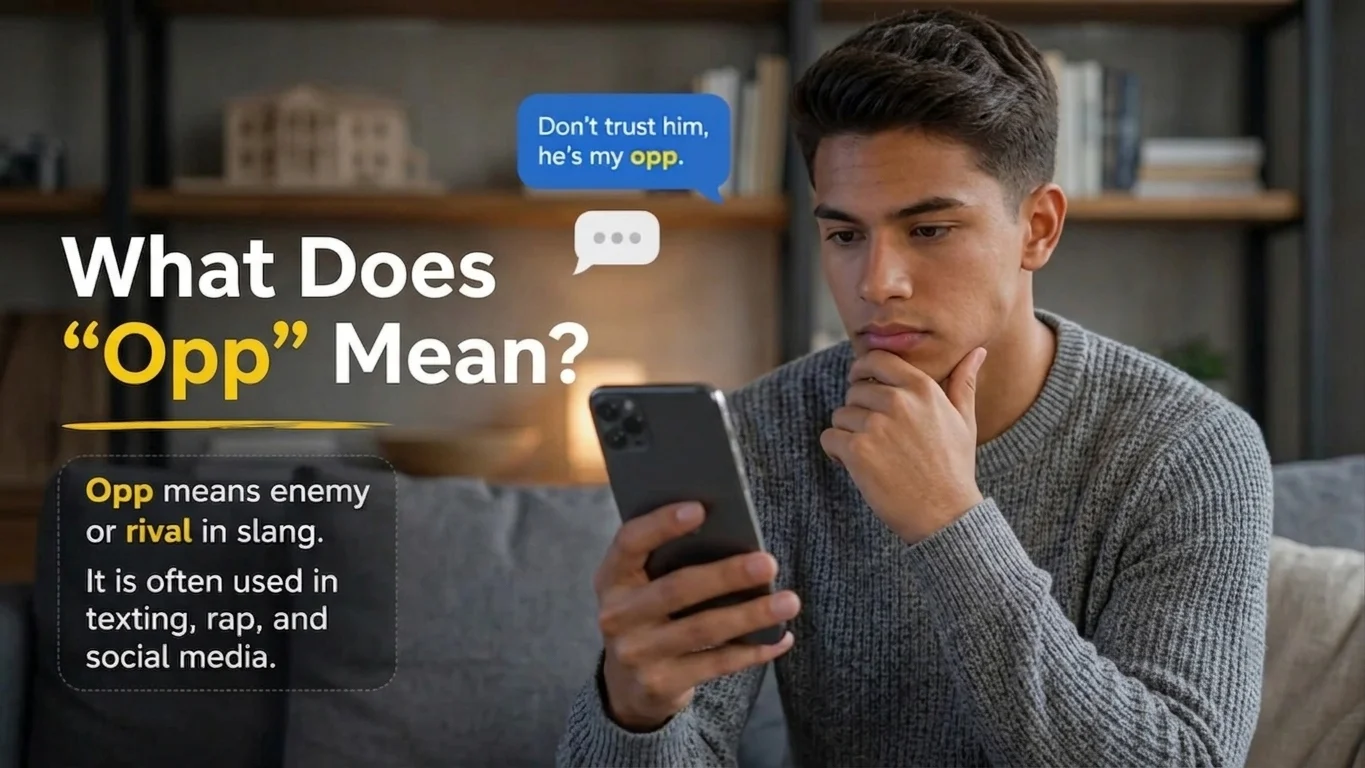
Ever received a text saying “He’s my opp” and wondered what it actually means? Opp meaning slang refers to an “opponent” or someone viewed as an enemy, rival, or person on the other side of a conflict.
The term is common in texting, social media, rap culture, gaming, and everyday online conversations, but its meaning can change slightly depending on context. Understanding the difference between a serious rival and casual slang can help you avoid misreading a message.
In this guide, you’ll discover where “opp” comes from, how people use it, real-life examples, related slang terms, and when it may be better to avoid using it.
Related Post: What Does KK Mean in Text? Meaning & Examples
What Does Opp Mean in Text?
In text messages, “opp” usually means opponent, rival, or enemy. It is an informal slang term that provides a shorter and more casual way to describe someone on the opposing side.
For example, if someone texts, “He’s my opp,” they may mean, “He’s my rival” or “He’s someone I’m against.” The seriousness depends on the relationship between the people involved.
The word is also frequently used jokingly. A person might text a friend, “You’re my opp now 😂,” after losing a video game or having a small disagreement. In this situation, there is usually no genuine hostility.
The important thing is context. The opp meaning slang users see online can range from a harmless joke to a serious reference to an actual rival. Looking at the surrounding conversation usually makes the intended meaning clear.
Opp Full Form
The most common explanations for “opp” are “opponent” and “opposition.” Both are connected to the basic idea of someone or something being on the other side.
An opponent is someone competing against you in a game, sport, debate, or other competitive situation. Opposition can refer to a person, group, or side that is against another person or group.
Common examples include:
“He’s my opp in the game.”
This means he is my opponent.
“That team is our opp.”
This means that team is our rival or opposing team.
“The opps are here.”
This generally refers to multiple rivals or opposing people.
The plural form “opps” is especially common in online conversations. However, slang does not always function like a formal abbreviation with one fixed definition. The meaning can change slightly between communities.
How Is Opp Used in a Conversation?
“Opp” is mainly used in casual conversations where informal slang is acceptable. You may hear or see it in texts, gaming chats, social media comments, sports discussions, and conversations between friends.
For example:
“That guy is an opp.”
This could simply mean that the person is a rival. In gaming, it may refer to an opposing player. In a more serious situation, it could refer to someone viewed as an enemy.
Friends also use the word for humor. Imagine two friends arguing over which football team is better. One might say, “You support them? You’re an opp!” The statement is likely playful rather than serious.
Because the word can have different levels of intensity, it is best to consider the speaker’s tone and the situation before interpreting it.
Opp Meaning Examples in Real Life
Real-life examples make the meaning of “opp” easier to understand because the word can be used in several different ways.
Gaming:
“Watch out, there’s an opp behind you.”
Here, “opp” means an opposing player.
Sports:
“Our opps have a strong defense.”
In this example, “opps” refers to the opposing team or players.
Among friends:
“You ate my fries. You’re an opp!”
This is usually a playful way of calling someone a rival.
Social media:
“My opp just liked my post.”
The speaker is referring to someone they consider a rival or opposing person.
Competition:
“I’m ready for my next opp.”
Here, “opp” simply means the next opponent.
These examples show that the same slang term can have different emotional meanings. It can describe competition, joking rivalry, or genuine opposition.
Meaning in Different Contexts
The opp meaning slang can change depending on where the term appears. Understanding the setting is one of the easiest ways to determine whether “opp” is being used seriously or casually.
In Text Messages
In texting, “opp” usually refers to a rival, opponent, or enemy. People use it because it is short, informal, and easy to understand among people familiar with the slang.
For example, “Why are you talking to my opp?” may mean, “Why are you talking to someone I consider a rival?”
However, a message such as “My friend is an opp 😂” is probably playful. Emojis and surrounding messages can provide useful clues about the intended tone.
On Social Media
On social media, “opp” appears in captions, comments, memes, and posts. Users may call someone an “opp” because they disagree with them or support an opposing opinion.
The word is also commonly exaggerated for humor. A minor disagreement about a movie, celebrity, food, or sports team can become an “opp” situation in a meme or comment.
In Rap Music
In rap and hip-hop contexts, “opp” can have a stronger meaning. It may refer to a rival, opposing person, or opposing group and can be connected with serious conflict.
The meaning should therefore be interpreted according to the lyrics and overall subject of the song. The term may carry more weight in music than it does in a casual meme or gaming chat.
In Gaming
Gaming is one of the easiest contexts for understanding “opp.” It commonly means opponent or opposing player.
A gamer might say, “That opp is really good,” meaning the other player is skilled. In this setting, the term does not necessarily imply personal hatred.
Among Friends
Friends often use “opp” as playful slang. Someone may call a friend an “opp” after losing a game, being teased, or experiencing a minor disagreement.
For example, “You picked their team? You’re an opp now.”
The exaggerated language makes the situation humorous rather than genuinely hostile.
In Sports Conversations
In sports, “opp” can mean an opposing player or team. Because competition is already part of sports, the word may simply be a casual alternative to “opponent.”
For example, “Our opps are having a great season” means the opposing team is performing well.
In Memes and Online Comments
Memes often use “opp” in an exaggerated way. Someone might write, “He likes pineapple pizza. Bro is an opp.”
The person is not necessarily a real enemy. The joke comes from treating a harmless disagreement as a serious rivalry.
Is opp rude, offensive, or neutral?
“Opp” can be neutral, playful, or offensive depending on the context. The word itself does not automatically make a statement rude.
Among friends, calling someone an “opp” may simply be a joke. In competitive situations, it can mean nothing more than opponent or rival.
However, the term can become more serious when it refers to a genuine enemy or person involved in an actual conflict. In that situation, calling someone an “opp” may communicate distrust or hostility.
If you are unsure about the tone, consider the conversation as a whole. The relationship between the speakers, emojis, subject matter, and surrounding words can all help determine the intended meaning.
Where is opp commonly used?
“Opp” is most commonly found in informal digital communication and popular culture. It appears in text messages, social media, gaming, sports discussions, memes, online comments, and music.
The term has become particularly familiar through internet culture, where short slang expressions spread quickly between different communities.
You may see variations such as “opp,” “opps,” “my opp,” and “the opps.” These forms generally maintain the same basic idea of opposition or rivalry.
Because slang can vary between communities, it is useful to avoid assuming that every person uses the word in exactly the same way.
Emotional and Psychological Meaning
Calling someone an “opp” can create a sense of opposition between two sides. In serious situations, it may communicate distrust, rivalry, anger, or hostility.
In casual conversations, the emotional meaning can be much lighter. Friends may use the term to make an ordinary disagreement sound dramatic.
For example, someone losing a video game might say, “That guy is my opp!” They may simply be frustrated about losing rather than expressing genuine hatred.
This difference explains why context matters so much. Slang often communicates attitude and humor in addition to its literal meaning.
Origin and Background of the Slang
“Opp” is generally understood as a shortened form of “opponent” or “opposition.” The term became especially recognizable through hip-hop and street-language contexts, where it could describe a rival or opposing person or group.
As social media and internet culture expanded, the word became more common outside those original contexts. Gaming, memes, sports discussions, and online conversations helped introduce it to broader audiences.
The plural “opps” generally refers to multiple rivals or opposing people.
Modern usage is more flexible than earlier uses. Someone can now use “opp” seriously, casually, sarcastically, or simply for humor.
Read More: The Ultimate List of Witty Ninja Turtles Puns and Jokes
Comparison with Similar Slang
“Opp” is similar to several words, but each has a slightly different meaning.
| Term | Meaning | Typical Tone |
|---|---|---|
| Opp | Opponent, rival, or enemy | Casual to serious |
| Opps | Multiple rivals or opponents | Casual to serious |
| Rival | Someone competing against you | Mostly neutral |
| Hater | Someone who dislikes or criticizes you | Negative |
| Enemy | Someone strongly opposed to you | Serious |
| Competitor | Someone competing with you | Neutral |
| Beef | A disagreement or conflict | Informal |
The key difference is that “opp” focuses on opposition or rivalry. A competitor does not necessarily dislike you, while an enemy usually implies a much stronger conflict.
Understanding these differences helps prevent slang from being interpreted too literally.
When to use opp
“Opp” is best suited to informal conversations. It can work naturally in texts, gaming chats, social media posts, sports discussions, and casual conversations with people who understand the slang.
For example:
“That player is my opp in this match.”
Or:
“You chose their team? You’re an opp now.”
The word is less suitable for professional emails, academic writing, official documents, or formal discussions. In those situations, terms such as “opponent,” “rival,” or “competitor” are clearer.
It is also important to consider your audience. Not everyone is familiar with modern slang, so using “opp” with someone unfamiliar with the term may create confusion.
Examples of Opp in Everyday Conversations
The following examples show how naturally “opp” can appear in everyday informal conversations.
Gaming:
“That player is an opp. Stay alert.”
Sports:
“Our opps are playing really well tonight.”
Friendship:
“You didn’t share your snacks? You’re an opp!”
Social media:
“My opp just followed me.”
Competition:
“I have to beat my opp in the final round.”
Online debate:
“Anyone who disagrees with him becomes an opp.”
The first five examples can be neutral or playful depending on the situation. The final example shows how “opp” can also be used critically when someone labels another person as an opponent simply because they disagree.
Common Misunderstandings About Opp
One common misunderstanding is that “opp” always means a dangerous or serious enemy. In reality, the word is frequently used casually and humorously.
Another misconception is that “opp” has only one official full form. “Opponent” and “opposition” are the most common explanations, but slang does not always follow strict abbreviation rules.
Some people also assume that calling someone an “opp” automatically means the speaker hates them. That is not necessarily true. Friends often use the word to describe harmless competition or playful rivalry.
The plural form “opps” can also cause confusion. It generally refers to multiple rivals or people on the opposing side.
The best way to interpret the term is to examine the context. A phrase like “My friend is an opp 😂” is likely a joke, while the same word in a serious conflict may have a much stronger meaning.
Frequently Asked Questions
What does opp mean in slang?
In slang, “opp” usually means opponent, rival, or enemy. Its tone can be playful or serious depending on the context.
What does opp stand for?
“Opp” commonly comes from “opponent” or “opposition.” It describes someone on the opposing side.
Is calling someone an opp offensive?
It can be offensive in a serious conflict, but among friends it is often harmless and playful. Context determines the tone.
Why do rappers say opp?
Rappers may use “opp” to describe rivals or opposing people or groups. Its meaning can depend on the cultural and lyrical context.
Is opp only used in America?
No. Although the term is strongly associated with American hip-hop and internet culture, it is now used by people in different countries, especially online.
Can opp mean a friend?
Yes. Friends sometimes call each other “opps” jokingly when teasing, competing, or pretending to be rivals.
Conclusion
Understanding opp meaning slang is easier when you consider the context. Most commonly, “opp” means an opponent, rival, or someone seen as being on the opposite side. It can appear in text messages, social media, gaming, sports, rap music, and casual conversations, with the tone ranging from playful to serious.
The key is not to assume that every use of “opp” means genuine hostility. Among friends or online, it may simply be a joke or casual expression. In more serious conversations, however, it can carry a stronger meaning. Knowing the context, audience, and relationship between the people involved helps you understand the word correctly, and use it appropriately.

Hi, I am admin of Punzline.com. I bring you the funniest puns and clever wordplay to keep your day full of laughs and smiles.