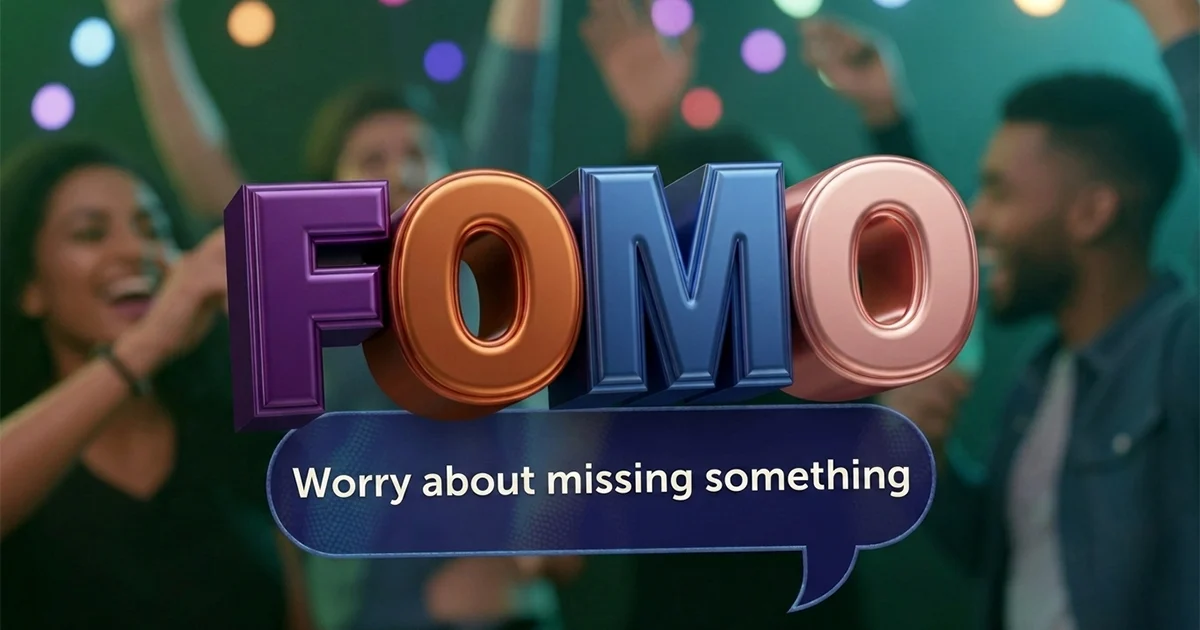
Have you ever felt like everyone is enjoying something without you? That feeling is often called FOMO meaning in text, short for “Fear of Missing Out.” You’ll commonly see FOMO in text messages, social media posts, chats, and online conversations when someone worries about missing an exciting event, trend, opportunity, or experience.
Understanding this popular slang can make digital conversations much easier to follow and help you recognize the emotion behind the message.
Whether you’re new to internet slang or simply want the exact FOMO definition, this guide explains its meaning, common uses, examples, and context in simple language. Keep reading to see how people naturally use FOMO in everyday conversations.
Quick Answer
FOMO meaning in text is “Fear of Missing Out.” It describes the feeling that you might be missing an exciting event, opportunity, experience, conversation, or activity that other people are enjoying.
In texting, someone may use FOMO to explain why they want to join a plan, check social media, attend an event, or stay updated with friends. For example, “I’m coming tonight because of FOMO” means the person does not want to miss what everyone else is doing.
FOMO is usually casual internet slang. It is common in text messages, social media posts, group chats, online conversations, and everyday communication among friends.
What Does FOMO Mean in Text
When someone asks “what does FOMO mean in text?”, they are usually asking about the slang meaning rather than a formal definition. FOMO stands for Fear of Missing Out, and it refers to anxiety or curiosity about being left out of something enjoyable, important, or socially relevant.
The feeling can happen when you see friends making plans without you, notice people attending an event, or scroll through posts showing others having fun. A simple message such as “Everyone is going to the concert, and now I have FOMO” expresses that feeling clearly.
FOMO can be positive or negative depending on the context. Sometimes it simply motivates someone to participate:
“I wasn’t going to go, but the FOMO got me.”
In other situations, it can describe unnecessary pressure to keep checking messages, social media, or group activities because someone worries they might miss something.
The important point is that FOMO does not describe a specific event by itself. It describes the emotional reaction to the possibility of missing out.
Full Form of FOM
The full form of FOMO is “Fear of Missing Out.”
Each letter represents a word:
| Letter | Word |
| F | Fear |
| O | Of |
| M | Missing |
| O | Out |
FOMO became especially common with the growth of social media and online communication. People can now see what friends, influencers, coworkers, and other users are doing almost instantly. This constant stream of updates can make someone feel that others are enjoying experiences they are not part of.
For example, if a friend sends a photo from a party and you reply, “Now I have FOMO,” you are saying that seeing the party makes you wish you were there too.
The abbreviation is now widely understood in casual digital communication, so people generally do not need to explain the full form when using it with friends or online audiences.
How FOMO Is Used in Text Messages
FOMO is normally used when someone wants to describe a feeling of not wanting to miss something. It can appear at the beginning, middle, or end of a text message
For example:
“Are you guys going to the game? I’m getting FOMO.”
Here, FOMO explains why the person is suddenly interested in joining.
Another example is:
“I have serious FOMO after seeing your pictures.”
This means the person wishes they had been part of the experience shown in the pictures.
FOMO can also be used humorously. Someone might say:
“I already have three plans this weekend, but I said yes to another one because of FOMO.”
In this case, the speaker is joking about accepting too many plans because they do not want to miss an opportunity.
You may also see phrases such as “FOMO kicked in,” “FOMO is real,” “major FOMO,” or “I’m feeling FOMO.” These expressions all communicate a similar idea, although the exact emotion depends on the conversation.
Real Conversation Examples
Seeing FOMO in realistic conversations makes its meaning easier to understand. The slang is flexible and can be used in different everyday situations.
With friends
Friend: “We’re going out for dinner tonight.”
You: “Wait, where? I’m getting FOMO already.”
Here, FOMO means you do not want to miss the social outing.
About an event
Friend: “The festival was amazing yesterday.”
You: “I should’ve gone. I have major FOMO.”
The speaker regrets missing the event after hearing about someone else’s experience.
In a group chat
Friend: “Everyone is meeting at 8.”
You: “Nobody told me! FOMO is hitting hard.”
This expresses the feeling of being left out.
On social media
Friend: “Look at all these beach photos.”
You: “Okay, now I have serious FOMO.”
The person sees others enjoying a trip and wishes they were there.
In a funny situation
Friend: “We’re watching one more episode.”
You: “I need to sleep, but the FOMO is stronger.”
The person knows they should stop but does not want to miss what happens next.
These examples show that FOMO can express genuine concern, mild regret, excitement, or playful exaggeration.
Is FOMO Casual, Formal, or Flirty
FOMO is primarily casual slang. It works naturally in texts, DMs, group chats, comments, captions, and conversations with friends.
It is generally not the best choice for formal business writing, academic assignments, official reports, or professional communication unless the context specifically discusses internet culture or the term itself.
FOMO is not inherently flirty, either. However, the surrounding conversation can give it a playful or romantic meaning.
For example:
“Everyone’s going out tonight. Don’t make me have FOMO 😏.”
The phrase itself is not romantic, but the emoji and context can make the message sound playful or suggestive.
Similarly, saying “I have FOMO because you guys are hanging out without me” is simply social. The meaning depends on who is involved and what the conversation is about.
A useful rule is simple: use FOMO freely in casual conversations, but choose clearer and more professional wording in formal settings.
Why Do People Use FOMO in Texting?
People use FOMO because it communicates a fairly complicated feeling in just four letters. Instead of writing “I feel like I might be missing something enjoyable that everyone else is experiencing,” they can simply say “I have FOMO.”
It is also useful because the meaning is widely recognizable in online conversations. The abbreviation makes messages shorter while still expressing the speaker’s emotional reaction.
FOMO can communicate several related feelings, including:
- Not wanting to be left out
- Regretting missing an event
- Wanting to join friends
- Feeling curious about what others are doing
- Worrying about missing an opportunity
- Feeling pressure to stay updated
- Joking about making too many plans
Social media can make FOMO especially noticeable because people constantly see selected moments from other people’s lives. A person may see photos from a party, vacation, concert, restaurant, or gathering and suddenly feel that they should have been there.
However, FOMO is not always serious. In everyday texting, people frequently use it casually or humorously.
FOMO Meaning on Social Media
On social media, FOMO means Fear of Missing Out, but the feeling can become more noticeable because users are exposed to constant updates about other people’s activities.
Someone might post “FOMO is real” after seeing friends at a concert. Another person might comment “Major FOMO!” under a vacation photo because they wish they had joined the trip.
You may see FOMO connected with:
- Parties and social events
- Concerts and festivals
- Travel
- Food and restaurants
- Shopping and limited-time offers
- Sports events
- Gaming
- Trending content
- Online communities
- New experiences
The phrase can also be used as a joke in captions and comments. For example, someone might write “FOMO made me book the trip” to explain an impulsive decision.
It is worth remembering that social media often shows selected highlights rather than someone’s complete experience. Seeing other people having fun can create the impression that everyone else is constantly doing something exciting, even when that is not the full reality.
When Should You Use FOMO in a Conversation?
Use FOMO when you want to casually express that you do not want to miss something or that seeing other people’s experiences has made you wish you were involved.
It works especially well when talking with friends about plans, parties, trips, games, concerts, social gatherings, or trending activities.
For example:
“Are you guys still going? I’m getting FOMO.”
“I skipped the party and now I have FOMO.”
“Your vacation pictures are giving me FOMO.”
“I wasn’t planning to buy tickets, but FOMO got me.”
Avoid using FOMO when the audience may not understand internet slang or when the conversation requires a formal tone. In those situations, phrases such as “I don’t want to miss out” or “I wish I could be there” are clearer.
Overall, FOMO meaning in text is simple: Fear of Missing Out. In casual messaging, it is a quick way to express the feeling of being left out, missing an opportunity, or wishing you were part of something others are experiencing.
Why FOMO Became So Popular
FOMO means “fear of missing out,” and the phrase became especially popular because it describes a feeling that is common in modern online communication. When people search for FOMO meaning in text, they are usually asking what the abbreviation means and how it is used in everyday messages, social media posts, comments, and casual conversations.
The popularity of FOMO is closely connected to social media. People constantly see friends attending events, traveling, buying products, joining trends, or enjoying experiences without them. This can create the feeling that something important or exciting is happening elsewhere. Instead of typing the full phrase, users simply write “FOMO” because the abbreviation is quick and widely understood.
FOMO also works well because it can describe both serious and humorous situations. Someone might say, “I have FOMO because everyone is going to the concert,” but they could also jokingly write, “Everyone ordered pizza without me. FOMO!” The meaning depends heavily on the context and tone.
Another reason FOMO spread so quickly is that it fits naturally into short-form digital communication. Texting, messaging apps, gaming chats, and social platforms encourage brief expressions. FOMO communicates a complete idea using only four letters, making it easy to type, recognize, and share.
In practical terms, FOMO is not usually a product, service, or platform, so questions about shipping time, product quality, customer experience, user reviews, or whether something is legit do not normally apply to the slang itself. Instead, the important question is how the word works in a particular conversation and what emotion the sender is trying to express.
Similar Slang Words to FOMO
Several slang terms are related to FOMO because they describe emotions, online behavior, or reactions to what other people are doing. Understanding these terms can make texting and social media conversations easier to follow.
YOLO means “you only live once.” It is often used to justify doing something exciting, spontaneous, or slightly risky. FOMO focuses on the fear of being left out, while YOLO focuses more on taking an opportunity and enjoying the moment.
JOMO means “joy of missing out.” It is almost the opposite of FOMO. Instead of feeling bad about missing an event or trend, someone experiencing JOMO feels comfortable staying away and enjoying their own time.
OMO can mean “obsession with missing out” in some online contexts, although it is much less common and less standardized than FOMO. Because slang meanings can vary between communities, context is important before assuming a particular definition.
AFK, meaning “away from keyboard,” is common in gaming and online chats. It does not mean the same thing as FOMO, but both can appear in conversations about online participation. For example, someone may be AFK while their friends are discussing an event they are afraid of missing.
| Slang | Meaning | Main Idea |
| FOMO | Fear of missing out | Concern about being left out |
| JOMO | Joy of missing out | Enjoying not participating |
| YOLO | You only live once | Taking opportunities |
| AFK | Away from keyboard | Temporarily offline or unavailable |
The important distinction is that FOMO describes a feeling, while terms such as AFK describe an online status or behavior. Knowing that difference helps prevent misunderstandings when reading informal messages.
When You Should Use FOMO
You can use FOMO when you want to describe the feeling that you might miss an enjoyable, important, or socially significant experience. It works best in casual conversations because FOMO is informal internet and texting slang.
For example, a friend might text, “Everyone is going to the beach this weekend. I’m getting major FOMO.” Here, FOMO clearly communicates that the person wishes they could participate.
You can also use it humorously. Someone might see pictures of friends eating at a restaurant and write, “Okay, now I have serious FOMO.” The statement does not necessarily mean the person is genuinely distressed. It can simply be a playful way of saying, “I wish I were there too.”
FOMO can also be useful when discussing online trends:
“I kept seeing everyone talk about that game, so I downloaded it because of FOMO.”
In this example, the person is saying that seeing other people participate influenced their decision.
However, FOMO is generally better suited to texts, social media, gaming chats, and conversations with friends than formal communication. In a professional email, academic paper, or official report, writing “fear of missing out” is usually clearer and more appropriate.
A simple rule is: use FOMO when the audience understands casual internet slang and the situation involves feeling left out or worried about missing something.
Common Mistakes When Using FOMO
One of the most common mistakes is assuming that FOMO means simply “I want something.” The term is more specific. It describes concern or anxiety about missing an experience because other people are participating or because the opportunity may disappear.
For example, saying “I want a new phone because I like it” is not necessarily FOMO. Saying “Everyone in my group upgraded their phones, and now I feel like I’m missing out” is much closer to the actual meaning.
Another mistake is using FOMO in situations where there is no sense of missing out. If someone cannot attend an event but is completely comfortable with that decision, FOMO may not be the right expression. JOMO, or simply saying “I’m happy staying home,” may better describe the situation.
People also sometimes confuse FOMO with jealousy. The two emotions can overlap, but they are not identical. Jealousy can involve wanting what another person has, while FOMO specifically involves concern that you are missing an experience, opportunity, trend, or social moment.
Context is another important factor. A message such as “FOMO 😭” could be serious, playful, exaggerated, or sarcastic. Emojis, previous messages, and the relationship between the people involved can change how the statement should be interpreted.
Finally, avoid forcing FOMO into every conversation simply because something is popular. Slang sounds most natural when it accurately describes the situation. Using it only because it is trending can make a message feel unnatural or confusing.
Why Understanding Text Slang Matters
Understanding text slang matters because digital conversations often rely on short expressions that cannot always be understood literally. A person who knows the FOMO meaning in text can quickly recognize that the sender is talking about a fear of missing an experience rather than simply making a random comment.
Slang knowledge can also reduce misunderstandings. Words such as FOMO, YOLO, JOMO, LOL, IMO, and IDK may look like ordinary combinations of letters to someone unfamiliar with online communication. Knowing their meanings makes texts, comments, captions, and group chats much easier to interpret.
There is also a social element. Internet slang changes quickly, and different communities may use the same expression in slightly different ways. Gaming communities, social media users, teenagers, workplaces, and online hobby groups can all develop their own communication habits. Paying attention to context is therefore just as important as memorizing definitions.
At the same time, understanding slang does not mean you need to use every abbreviation yourself. Good communication is about choosing language that fits the audience. Casual slang may work perfectly in a group chat but sound inappropriate in a formal message.
The best approach is to understand the meaning first, look at how people actually use the term, and then decide whether it fits your own conversation. This makes your communication clearer and helps you recognize the difference between genuine emotional meaning, humor, exaggeration, and internet trends.
Final Thoughts
The simplest answer to FOMO meaning in text is “fear of missing out.” It describes the feeling that you may be missing an enjoyable, valuable, or socially important experience while other people are taking part.
FOMO is especially common in texting, social media, gaming communities, and casual online conversations because it expresses a familiar modern experience in just four letters. It can be serious, but it is often used casually or humorously as well.
The key is context. If someone says they have FOMO, they usually mean they wish they could participate or are concerned about being left out. Once you understand that basic idea, recognizing and using FOMO in everyday digital communication becomes much easier.

Hi, I am admin of Punzline.com. I bring you the funniest puns and clever wordplay to keep your day full of laughs and smiles.